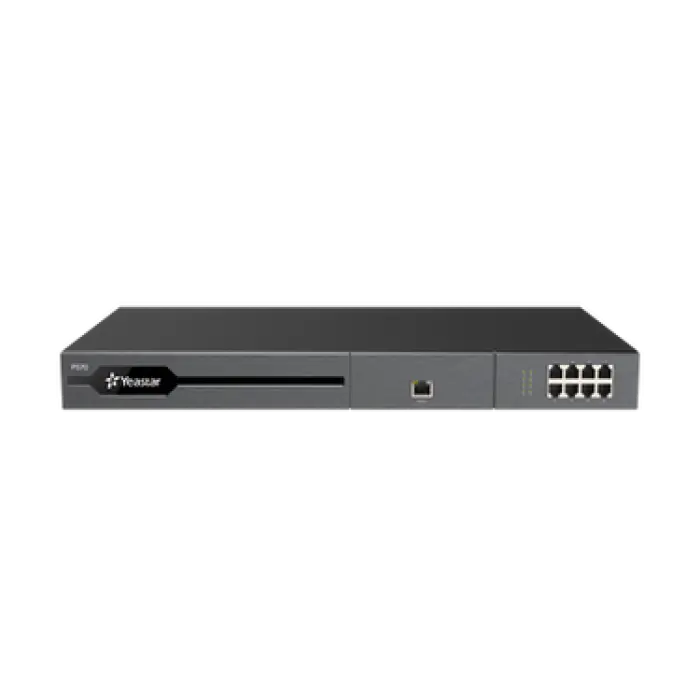
Yeastar P560 P-Series IP PBX
The Yeastar P560 provides enterprise-level unified communications for organizations requiring up to 1,000 users and 200 concurrent calls. This on-premises IP PBX system delivers comprehensive telephony features without recurring cloud subscription fees, making it ideal for large enterprises, multi-site operations, and high-volume call centers. Organizations demanding complete control over their communication infrastructure will find the P560 suitable for complex deployment scenarios requiring extensive scalability and integration capabilities.
Technical Specifications
System Capacity
- Users: Up to 1,000 extensions
- Concurrent Calls: 200 simultaneous connections
- Voicemail Storage: 400 hours recording capacity
- Call Recording: Unlimited duration with external storage expansion
- Conference Bridges: Up to 30 simultaneous conference rooms
Connectivity & Interfaces
- Network Ports: Dual Gigabit Ethernet (LAN1, LAN2) with failover support
- Telephony Expansion: 4 module slots for interface cards
- Supported Protocols: SIP, IAX2, ISDN PRI/BRI, SS7, analog FXS/FXO
- USB Ports: 2× USB 3.0 for storage expansion and backup
- Console Port: RJ45 serial interface for direct administration
Performance & Processing
- Processor: Hexa-core 2.0GHz
- RAM: 8GB DDR4
- Storage: 128GB SSD with RAID support
- Transcoding Capacity: 200 channels hardware transcoding
- Codec Support: G.711, G.722, G.726, G.729, Opus, iLBC
Integration Capabilities
- CRM Platforms: Native connectors for Salesforce, Microsoft Dynamics, Zoho, SugarCRM
- Microsoft Integration: Teams Direct Routing, Exchange calendar integration
- Directory Services: LDAP, Active Directory synchronization
- API Framework: RESTful API with WebSocket support for real-time events
- Hotel/Property Management: PMS integration for hospitality deployments
Physical Specifications
- Form Factor: 440mm × 440mm × 44mm (1U rackmount)
- Weight: 4.8kg
- Power Supply: Dual hot-swappable 100-240V AC PSUs
- Power Consumption: 65W typical, 85W maximum
- Operating Temperature: 0°C to 50°C
- Humidity: 10% to 90% non-condensing
- Certifications: CE, FCC, IC, RoHS, REACH compliant
Use Cases & Applications
Large Enterprise Deployments: The P560 serves organizations with extensive communication needs across multiple departments and locations. Centralized administration simplifies management while distributed architecture enables regional resilience.
High-Volume Contact Centers: Businesses handling substantial customer interaction volumes benefit from advanced queue algorithms and real-time monitoring. Supervisors access live metrics, whisper coaching, and call barging without disrupting agent workflows.
Healthcare Facilities: Hospitals and medical centers utilize paging integration, emergency notification, and HIPAA-compliant call recording. Extension mobility allows medical staff to receive calls at their current location rather than fixed desk phones.
Manufacturing Operations: Industrial facilities connect legacy equipment through analog and digital interfaces while modernizing with IP technology. Paging systems and intercoms integrate directly, eliminating separate communication infrastructure.
Hospitality Industry: Hotels leverage PMS integration for automated guest billing, wake-up calls, and room status management. The system handles front desk operations, internal communications, and guest services through unified administration.
Educational Institutions: Universities and schools deploy the P560 for campus-wide communications, connecting administrative offices, classrooms, and emergency systems. Integration with door phones and intercoms enhances campus security coordination.
Deployment Considerations
The Yeastar P560 requires proper network infrastructure including VLAN segmentation and Quality of Service (QoS) policies. Voice traffic should utilize dedicated VLANs with DSCP markings to ensure consistent call quality during network congestion.
Organizations planning high-availability deployments can configure master-slave failover configurations. The secondary system maintains synchronized configuration, automatically assuming operation if the primary unit fails.
Bandwidth planning should account for codec selection and concurrent call requirements. Using G.729 compression, each call consumes approximately 32kbps including overhead. Organizations should provision sufficient bandwidth at each site plus 20% overhead for signaling traffic.
Storage expansion via USB enables extended call recording retention. Organizations with compliance requirements should implement automated backup strategies using the built-in scheduling features to external NAS or server storage.
Initial setup involves network configuration, trunk provisioning, extension creation, and integration testing. Straightforward deployments typically complete within 6-8 hours, while complex scenarios involving CRM integration and custom IVR development may require several days of configuration and testing.
Session Border Controller functionality protects against VoIP security threats when connecting to external SIP providers. Organizations should enable SIP encryption (TLS/SRTP) for remote workers and branch office connections traversing public networks.



 No products in the cart.
Reviews
There are no reviews yet.