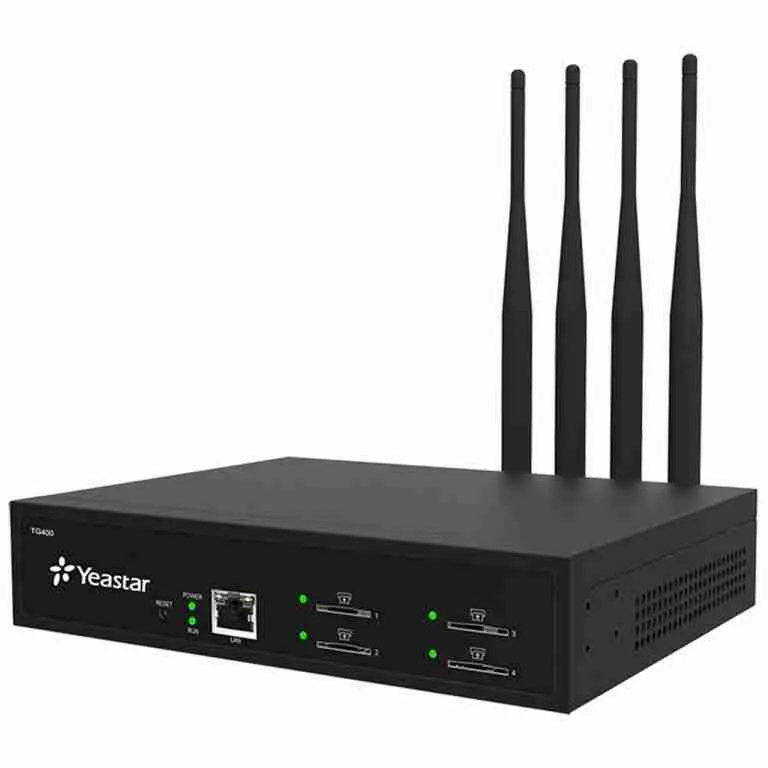
Yeastar TG400 4-Port GSM VoIP Gateway
The Yeastar TG400 bridges cellular networks with VoIP phone systems through four simultaneous GSM connections. This gateway enables businesses to reduce telecommunication costs by routing calls through mobile networks while maintaining existing IP PBX infrastructure. Organizations in areas with expensive landline services, unreliable fixed-line connectivity, or requiring mobile number presentation will find the TG400 essential for cost optimization and communication flexibility.
Technical Specifications
GSM Capabilities
- Channels: 4 GSM ports (4 concurrent calls)
- Frequency Bands: GSM 850/900/1800/1900 MHz (quad-band)
- Network Compatibility: 2G GSM networks worldwide
- SIM Support: Standard SIM cards (2FF format)
- Signal Strength: -109 dBm minimum sensitivity
- Antenna Connectors: 4× SMA female connectors (50Ω impedance)
VoIP Performance
- Protocol Support: SIP, IAX2
- Codec Support: G.711 (A-law/μ-law), G.722, G.726, G.729, GSM
- Echo Cancellation: ITU-T G.168 compliant (128ms tail length)
- DTMF: RFC 2833, SIP INFO, In-band detection
- Jitter Buffer: Adaptive 0-300ms
- Packet Loss Concealment: Yes
Network & Connectivity
- Network Interface: Single 10/100Mbps Ethernet port
- IP Configuration: Static IP, DHCP, PPPoE support
- NAT Traversal: STUN support
- Network Protocols: IPv4, UDP, TCP, RTP
- Management: Web-based GUI, CLI access
SMS Functionality
- SMS Modes: PDU mode, Text mode
- Message Storage: 1000 messages internal memory
- SMS API: HTTP API for application integration
- Encoding Support: GSM 7-bit, UCS2 (Unicode)
- Concatenated SMS: Long message support (up to 918 characters)
Physical Specifications
- Dimensions: 440mm × 180mm × 44mm (1U rackmount)
- Weight: 1.8kg (without antennas)
- Power Supply: 100-240V AC, 50/60Hz (included adapter)
- Power Consumption: 15W typical, 25W maximum
- Operating Temperature: -10°C to 50°C
- Storage Temperature: -20°C to 60°C
- Humidity: 10% to 90% non-condensing
- Certifications: CE, FCC, RoHS compliant
Package Contents
- 1× TG400 gateway unit
- 4× GSM antennas (2dBi gain)
- 1× Power adapter
- 1× Ethernet cable
- 1× Rackmount kit
- Quick installation guide
Use Cases & Applications
Cost Optimization Strategies: Businesses operating in regions where mobile rates significantly undercut landline costs route outbound calls through the TG400. Organizations with unlimited mobile plans maximize these subscriptions by channeling office calls through GSM networks instead of expensive SIP trunking.
Rural and Remote Locations: Facilities in areas lacking reliable internet connectivity or landline infrastructure utilize GSM networks as primary telephony transport. Construction sites, agricultural operations, and temporary locations establish immediate communication systems without awaiting physical line installation.
Mobile Number Presentation: Companies maintaining established mobile numbers for customer recognition present these numbers through office phone systems. Sales teams and customer service departments display familiar mobile caller IDs while using desk phones, improving answer rates and maintaining professional consistency.
Disaster Recovery: Organizations implement the TG400 as backup communication infrastructure during internet or power outages affecting primary VoIP services. The gateway automatically routes calls through cellular networks when detecting SIP trunk failures, maintaining business operations during carrier disruptions.
Multi-Location Deployments: Retail chains and franchise operations connect multiple sites using GSM networks instead of dedicated circuits. Each location maintains local mobile numbers while enabling free inter-site calling through VoIP connectivity between TG400 units.
SMS Notification Systems: Businesses integrate automated SMS capabilities for appointment reminders, delivery notifications, and two-factor authentication. Call centers send follow-up messages, while service companies confirm technician arrivals without separate messaging platforms.
International Operations: Companies with overseas branches leverage local SIM cards to reduce international calling costs. Calls between headquarters and branch offices route through internet connections, while local outbound calls utilize cost-effective GSM channels.
Deployment Considerations
The Yeastar TG400 requires network connectivity and proper antenna placement for optimal signal reception. Organizations should position antennas away from electronic interference sources and metal obstructions, ideally with line-of-sight to cell towers.
SIM card selection impacts functionality and cost optimization. Businesses should evaluate carrier coverage at installation locations, compare per-minute rates, and consider unlimited calling plans for high-volume deployments. Pre-paid SIM cards suit low-usage scenarios while post-paid contracts benefit consistent high-volume operations.
Integration with IP PBX systems involves configuring trunk connections and dial rules. The TG400 registers as standard SIP trunks on systems including Yeastar, Asterisk, FreeSWITCH, and commercial PBX platforms. Outbound routing rules determine which calls utilize GSM channels versus alternative trunks.
Call quality depends on cellular network conditions. Organizations should monitor signal strength through the web interface and relocate antennas if measurements fall below -95 dBm. Poor signal causes dropped calls, audio delays, and reduced connection reliability.
SMS integration requires API configuration for application connectivity. Developers access HTTP endpoints to send messages programmatically, while the gateway forwards incoming SMS to designated extensions or external applications through webhooks.
Load balancing across multiple SIM cards distributes call volume and prevents individual channel saturation. The gateway supports round-robin distribution, sequential selection, or custom routing based on destination prefixes. Organizations configure failover sequences ensuring backup channels activate when primary connections become unavailable.
Power backup through UPS systems maintains gateway operation during electrical outages. The TG400 consumes minimal power, enabling extended runtime on modest battery systems compared to traditional PBX equipment.
Initial configuration involves accessing the web interface, configuring network parameters, registering SIM cards, and establishing trunk connections to IP PBX systems. Basic deployments complete within 30-60 minutes, while complex routing scenarios requiring custom dial plans may extend configuration time to several hours.


 No products in the cart.
Reviews
There are no reviews yet.