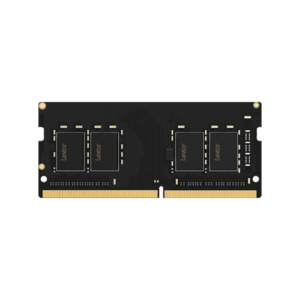
16GB Single-Module Capacity: Doubles usable RAM compared to a typical factory-installed 8GB stick, giving browsers, office suites, and background services considerably more headroom before the system slows.
3200MHz JEDEC-Standard Performance: Runs at the standard 3200MHz DDR4 speed without requiring XMP configuration in BIOS — plug in, power on, and the system recognises it immediately.
1.2V Low-Voltage Operation: Draws less power than older DDR3 modules, which translates to marginally lower heat output and reduced strain on laptop batteries during extended use.
260-Pin SO-DIMM Form Factor: Matches the memory slot standard in virtually all modern laptops — including those from Dell, HP, Lenovo, Acer, ASUS, and MSI — making this a drop-in upgrade with no additional hardware required.
Lexar Quality Lab Tested: Lexar tests its memory across an extensive library of devices before release, reducing the risk of compatibility issues or premature failure in the field.
5600MT/s Transfer Speed: Handles simultaneous browser tabs, design tools, and background processes without slowing down, keeping your workflow uninterrupted.
On-Die Error Correction Code (ECC): Detects and corrects minor data errors at the chip level automatically, improving stability during long work sessions.
Low 1.1V Operating Voltage: Consumes less power than DDR4 modules, which consequently helps extend battery life and reduces heat output in slim laptops.
Plug-and-Play Installation: No tools or configuration are required. The module slots directly into any compatible DDR5 SODIMM slot and is recognised immediately on boot.
Lifetime Limited Warranty: Lexar backs this module with a comprehensive lifetime warranty, reflecting confidence in its long-term reliability under normal use.
32GB Single UDIMM Capacity: Provides substantial working memory in a single 288-pin slot, leaving remaining slots free for future expansion or dual-channel pairing — useful in ATX and mATX builds with four memory slots.
JEDEC-Standard 3200MHz Operation: Runs at 3200MHz and remains backwards compatible with lower DDR4 speeds including 2666MHz, ensuring the module trains correctly on older DDR4 motherboards that do not support the full 3200MHz frequency.
CL22 at 1.2V: Operates within the standard DDR4 voltage envelope, producing less heat than higher-voltage performance kits — an advantage in compact desktop form factors with limited airflow.
Non-ECC Unbuffered Design: Compatible with desktop motherboards that support non-ECC unbuffered DDR4 memory slots, covering the vast majority of consumer and prosumer Intel and AMD desktop platforms.
Limited Lifetime Warranty: Lexar backs this module with a limited lifetime warranty, providing long-term assurance backed by Lexar's history as a former part of Micron, one of the world's biggest DRAM and NAND manufacturers.
32GB Single-Module Capacity: Fills a single SO-DIMM slot with 32GB of working memory — ideal for slim laptops and ultrabooks where only one memory slot exists, or where the second slot houses soldered RAM.
3200MHz JEDEC-Standard Speed: Runs at 3200MHz (PC4-25600) out of the box with no BIOS configuration required, and remains backwards compatible with lower DDR4 frequencies including 2933MHz, 2666MHz, 2400MHz, and 2133MHz.
CL22 Latency at 1.2V: Delivers a consistent timing profile of 22-22-22-52 at 1.2 volts, keeping power draw low and heat output minimal — important considerations inside thermally restricted laptop chassis.
JEDEC Compliance for Broad Compatibility: Works with a wide range of DDR4 SO-DIMM-compatible notebook platforms from major manufacturers including Dell, HP, Lenovo, ASUS, Acer, and MSI, without requiring vendor-specific XMP profiles.
Limited Lifetime Warranty: Lexar backs this module with a limited lifetime warranty, providing long-term assurance for both personal users and professional environments.
3200MHz Clock Speed: Delivers a bandwidth ceiling of PC4-25600 (25,600 MB/s), improving responsiveness over lower-speed DDR4-2666 modules in multitasking scenarios.
288-Pin UDIMM Form Factor: Fits standard full-size desktop motherboard memory slots directly. It works with Intel and AMD platforms that support DDR4, without requiring adapters or special configuration.
CL22 JEDEC Timing (22-22-22): Runs at rated speed out of the box. No XMP profile activation or manual timing adjustment is necessary in most BIOS environments.
1.2V Low-Voltage Operation: Draws less power than DDR3 equivalents, reducing heat output during sustained desktop workloads and contributing to overall system stability.
Lexar Quality Labs Verified: Each module passes compatibility and stability testing across a wide range of devices, reducing the likelihood of system instability or boot issues post-installation.
3200MHz Data Rate: Transfers data at up to 25,600 MB/s (PC4-25600), reducing application load times compared to lower-speed DDR4 modules such as 2666MHz variants.
Low 1.2V Operating Voltage: Draws less power than older DDR3 memory, which helps extend battery runtime and reduces heat output during sustained use.
260-Pin SO-DIMM Form Factor: Fits standard laptop memory slots directly — no adapters or configuration changes required. Installation involves removing the existing module and seating the new one.
CL22 JEDEC Timing (22-22-22): Factory-set timings follow the JEDEC standard, so the module runs at rated speed immediately without manual BIOS adjustments.
Lexar Quality Labs Tested: Each module undergoes compatibility and stability testing across a broad range of devices, reducing the risk of boot failures or instability after installation.
Up to 560 MB/s Read and 500 MB/s Write: Transfers files approximately five times faster than a mechanical external hard drive — a 10GB video file that would take over three minutes on an HDD moves in under 20 seconds, making the T300S practical for working directly from the drive rather than copying files first.
Aluminium Alloy Body with 1m+ Drop Resistance: The outer housing combines aluminium alloy with PC+ABS material, providing structural rigidity against everyday impacts. Additionally, with no mechanical components inside, there are no moving parts to fail under vibration or shock — offering substantially better resilience than portable HDDs.
Compact 78.3 × 61.4 × 12.45mm Form Factor, 48g: Small enough to sit alongside a credit card in a jacket pocket, the T300S adds negligible weight and volume to any bag or backpack. Furthermore, a single USB-C cable handles both data and power, eliminating the need for a separate power adapter.
USB Type-C with Included Adapters: Ships with both a USB-C to C cable and a USB-C to A adapter, making it compatible with modern USB-C-only laptops and older USB-A ports without purchasing additional accessories.
Broad Cross-Platform Compatibility: Works natively with Windows, macOS, and Android 4.0 or above via OTG — covering the full range of devices a typical mobile professional uses daily, without driver installation.
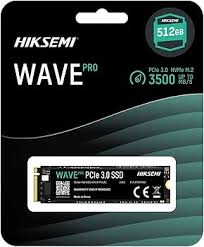
2,280 MB/s Sequential Read Speed: Delivers approximately four times the throughput of a typical SATA SSD. Boot times, application launches, and file transfers all respond faster under everyday use.
PCIe 3.0 x4 NVMe Interface: Connects directly to the CPU via the PCIe bus, bypassing the SATA controller entirely. This reduces latency compared to SATA-based M.2 drives, which share the same pathway as older HDDs.
3D NAND Flash Storage Medium: Memory cells are stacked vertically across multiple layers. Consequently, the drive achieves higher density and improved endurance relative to older planar NAND designs.
100 TBW Endurance Rating: Rated for 100 terabytes written over its service life, with an MTBF of 1,500,000 hours. This is suitable for typical daily workloads including document editing, web browsing, and moderate file transfers over several years.
Low 1.6W Power Consumption: The HIKSEMI WAVE 256GB NVMe draws only 1.6W at peak load. This makes it a practical choice for laptops where thermal headroom and battery life are relevant considerations.
2,230 MB/s Sequential Read Speed: Substantially faster than SATA-based M.2 drives, which cap at around 560 MB/s. Boot times and large file transfers benefit directly from the PCIe 3.0 x4 NVMe interface.
2,000 MB/s Sequential Write Speed: The 512GB capacity allows the HIKSEMI WAVE(P) to achieve notably higher write throughput than the 256GB model. This makes it more capable for tasks involving regular large writes, such as video exports and software installations.
460K Random Read IOPS: High random read performance reduces the micro-delays that accumulate during multitasking. Opening multiple applications simultaneously, switching between browser tabs, and running background processes all feel more responsive as a result.
3D NAND Flash Technology: Cells are stacked vertically, improving storage density and write endurance relative to older planar NAND. Additionally, this architecture contributes to the drive's stable thermal behaviour under sustained load.
120 TBW Endurance with 3-Year Warranty: The HIKSEMI WAVE 512GB NVMe is rated for 120 terabytes written over its service life. The 3-year warranty provides coverage for typical consumer and light professional workloads.
2,600 MB/s Sequential Write Speed: Substantially faster than the 500GB PRO variant's 1,700 MB/s write ceiling, the 1TB NM610 PRO consequently handles large file installations, game updates, and creative project saves with noticeably less waiting.
PCIe Gen3x4 NVMe 1.4 Interface: Delivers sequential read speeds up to 3,300 MB/s — approximately six times faster than SATA SSDs — so boot times and application launches remain consistently responsive.
3D TLC NAND Flash: Uses 3D TLC NAND for a reliable balance of speed, write endurance, and everyday durability across mixed-use workloads.
240 TBW Endurance Rating: Rated for 240 terabytes written over its lifespan, the LNM610 PRO 1TB therefore offers double the write endurance of the 500GB variant, making it better suited to heavier daily workloads.
Shock and Vibration Resistance: Rated to 1,500G shock resistance with no moving parts. As a result, this drive withstands the rigours of mobile use and transportation far more reliably than any mechanical hard drive.
PCIe Gen3x4 NVMe 1.4 Interface: Reaches sequential read speeds up to 3,300 MB/s — approximately six times faster than SATA SSDs — so boot times and application launches feel noticeably more responsive.
Improved Write Performance Over Standard NM610: At up to 1,700 MB/s sequential write, the NM610 PRO therefore outperforms the original NM610's 1,600 MB/s write ceiling, making it better suited to frequent large-file saves and installations.
3D TLC NAND Flash: Uses 3D TLC NAND for a reliable balance of read speed, write endurance, and cost efficiency across everyday mixed workloads.
Shock and Vibration Resistance: Rated to 1,500G shock and 20G vibration resistance across all axes. Consequently, it handles the rigours of mobile use and transportation far better than any mechanical hard drive.
Compact M.2 2280 Form Factor: Measuring 80 × 22 × 2.45 mm and weighing just 9 g, the LNM610 PRO fits standard M.2 slots in ultrabooks, mid-tower desktops, and compact ITX builds without modification.
PCIe Gen3x4 NVMe 1.4 Interface: Achieves sequential read speeds up to 3,300 MB/s — roughly six times faster than SATA SSDs — so your system boots faster and applications respond without delay.
3D TLC NAND Flash: Built on 96-layer Micron 3D TLC NAND, the NM620 balances endurance and read performance well for daily OS and application use.
LDPC Error Correction: Low Density Parity Check technology identifies and corrects data errors in real time, therefore keeping transfers accurate even under sustained load.
Shock and Vibration Resistance: Rated to 1,500G shock resistance with no moving parts, making this drive far more resilient than any mechanical alternative in portable or desktop systems.
Lightweight M.2 2280 Form Factor: At just 9 g and 80 × 22 × 2.25 mm, the LNM620 slots cleanly into ultrabooks, compact desktops, and full-size towers without adapters.
7400MB/s Sequential Read Speed: Loads large game files and high-resolution assets noticeably faster than PCIe Gen 3 drives, which top out around 3500MB/s.
Host Memory Buffer (HMB) 3.0: The drive borrows system DRAM instead of carrying its own cache chip. Consequently, this reduces power draw by up to 40% compared to DRAM-enabled Gen 4 SSDs — a practical benefit for laptop battery life.
Dynamic SLC Cache: Incoming writes are temporarily stored in single-level-cell mode. This maintains consistent write throughput during sustained workloads such as large file transfers or game installations.
3D TLC NAND Flash: Three-dimensional cell stacking delivers a rated endurance of 1,000 TBW, making the drive suitable for daily heavy use over many years.
PS5 Compatible: The NM790 meets Sony's storage expansion requirements for the PlayStation 5. Furthermore, the drive fits the console's M.2 slot without modifications.
7400MB/s Sequential Read Speed: Matches the performance of the 1TB variant at twice the capacity. Large game libraries, RAW photo archives, and 4K project files load without the bottlenecks common on PCIe Gen 3 drives.
1,500 TBW Endurance Rating: The 2TB model carries 50% more write endurance than the 1TB version. This makes it well suited for workloads involving frequent large writes, such as video editing and database operations.
HMB 3.0 Architecture: Rather than relying on a dedicated DRAM cache chip, the drive uses Host Memory Buffer 3.0 to leverage existing system memory. Consequently, power consumption runs up to 40% lower than comparable DRAM-enabled Gen 4 SSDs.
Dynamic SLC Cache: Write bursts are temporarily handled in single-level-cell mode, maintaining consistent throughput during sustained transfers. This prevents the speed dips that cacheless drives often exhibit under heavy load.
Maxio MAP1602 Controller: This 12nm controller supports PCIe Gen 4x4 and NVMe 1.4, delivering up to 1,000,000 random read IOPS. Additionally, its efficient design contributes to the drive's low thermal output.
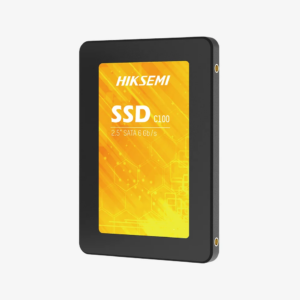
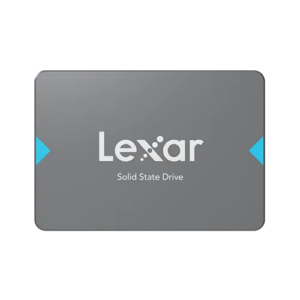
550 MB/s Sequential Read: Delivers substantially faster boot times and application load speeds compared to any conventional spinning hard drive, reducing typical Windows startup from over a minute to under 20 seconds.
3D TLC NAND Flash (Micron, 96-Layer): Uses stacked NAND architecture to achieve higher storage density at a lower cost per gigabyte, making 1TB of solid-state storage accessible without a premium price tag.
No Moving Parts: Unlike a traditional HDD, the NQ100 has no spinning platters or actuator arms. Additionally, this means it generates no noise and produces significantly less heat during operation.
Shock and Vibration Resistance: Rated to withstand shocks up to 1500G and vibration across a 10–2000Hz range, making it more resilient than an HDD for mobile use in laptops carried daily.
Drop-In SATA Compatibility: Uses the standard SATA III (6Gb/s) interface and 2.5-inch form factor. However, it also works in SATA II ports at reduced speed, covering a wide range of older hardware without adapters.
550 MB/s Sequential Read: Reaches the practical ceiling of the SATA III interface, reducing Windows boot times to under 20 seconds and delivering near-instant application launches — a significant step up from any 5400 or 7200 RPM hard drive.
672 TBW Endurance Rating: Rated for 672 terabytes of total data written over its lifetime, equating to approximately 0.32 drive writes per day across a three-year warranty period — adequate for everyday computing and light creative workloads.
Shock Resistance to 1500G: Withstands impacts up to 1500G (0.5ms, Half Sine Wave) and vibration across 7–800Hz, making it more resilient than a spinning hard drive for laptops carried daily between locations.
No Moving Parts — Silent and Energy Efficient: Without platters or actuators, the NQ100 produces zero mechanical noise and generates less heat than an HDD, consequently reducing thermal load in compact laptop chassis.
Operating Temperature Range 0°C–70°C: Covers standard computing environments reliably, while the -40°C to 85°C storage temperature range ensures data integrity across a wide range of transport and storage conditions.





 No products in the cart.