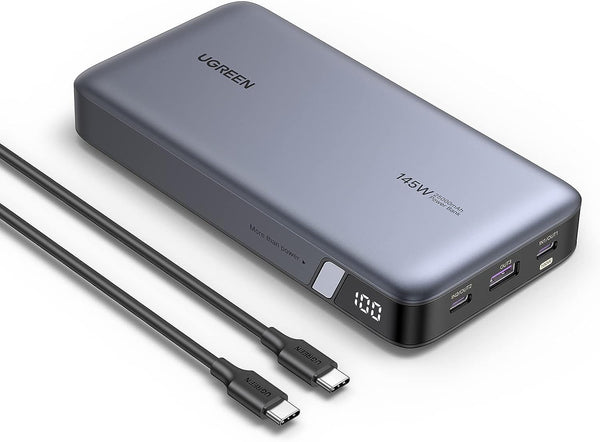
UGREEN 25000mAh 145W Two-Way Fast Charging Power Bank
The UGREEN 25000mAh 145W power bank (SKU 90597A) is a high-capacity portable charger built for users who need to power laptops, tablets, and smartphones away from a wall outlet — without compromising on charging speed. It delivers up to 140W from a single USB-C port, enough to fast-charge a 16-inch MacBook Pro, and recharges itself fully in approximately two hours via a 65W input. With three output ports, a digital battery percentage display, and a 90Wh capacity that stays within international airline hand-luggage limits, it suits business travellers, remote workers, content creators, and anyone who routinely runs multiple high-draw devices on the move.
Why Output Wattage Matters for Laptop Charging
Most conventional power banks top out at 20W or 30W — sufficient for phones but inadequate for laptops. A MacBook Pro, Dell XPS, or HP Spectre connected to a 20W source charges slower than it discharges under active use, providing effectively no benefit during a working session. The 90597A’s USB-C1 port outputs up to 140W solo, exceeding the charging requirement of virtually every USB-C laptop on the market and matching what a wired wall adapter delivers. Consequently, a 16-inch MacBook Pro reaches 56% charge in 30 minutes — enough to extend a working session by several hours from a brief top-up opportunity.
Two-Way Charging: Recharge the Bank and Devices Simultaneously
Unlike standard power banks that suspend output while recharging, the 90597A supports bidirectional pass-through charging. Connect a 65W PD charger to USB-C1 as input, and the bank distributes power to connected devices at the same time as it replenishes its own battery. This matters in situations where charging time is limited — an airport lounge, a meeting room, or a car journey — because a single 65W adapter serves both the bank and the attached device in one operation. Furthermore, the bank itself recharges from flat to full in approximately two hours at 65W input, compared to over six hours on a standard 5W charger.
Port Priority and Power Allocation
Understanding how the three ports divide power prevents unexpected slow charging. USB-C1 is the priority port: it always outputs up to 100W regardless of which other ports are active. USB-C2 delivers up to 45W alone, reducing to 15W when USB-C1 is simultaneously in use. USB-A outputs up to 18W alone via QC3.0, dropping to 15W when shared. When all three ports operate together, total combined output caps at 115W — not 145W — so the USB-C2 and USB-A devices charge at reduced rates while USB-C1 maintains priority throughput.
Technical Specifications
Battery
| Property | Detail |
|---|---|
| Capacity | 25,000mAh / 90Wh (typical) |
| Cell Voltage | 3.6V |
| Chemistry | Lithium-ion |
| Airline Carry-On Compliance | Yes — 90Wh (under IATA 100Wh limit) |
Output Ports
| Port | Solo Max | Shared Max |
|---|---|---|
| USB-C1 (Priority) | 140W | 100W (always maintained) |
| USB-C2 | 45W | 15W (with C1 active) |
| USB-A | 18W (QC3.0) | 15W (with other ports active) |
| All 3 Ports Combined | — | 115W total |
| C1 + C2 Combined | — | 145W total |
Input
| Property | Detail |
|---|---|
| Input Port | USB-C1 |
| Max Input Power | 65W |
| Recharge Time (65W) | ~2 hours (0–100%) |
| Recharge Time (5W) | ~6+ hours |
Supported Fast-Charge Protocols
| Protocol | Support |
|---|---|
| USB Power Delivery | PD3.1, PD3.0, PD2.0 |
| Qualcomm Quick Charge | QC3.0 |
| Programmable Power Supply | PPS |
| Huawei Fast Charge | FCP |
| Samsung Fast Charge | AFC |
| Standard | BC1.2 |
Protection Features
| Protection Type | Included |
|---|---|
| Over-voltage | Yes |
| Over-current | Yes |
| Over-discharge | Yes |
| Over-temperature | Yes |
| Short circuit | Yes |
Physical
| Property | Detail |
|---|---|
| Dimensions | 160 × 80.7 × 26.7mm (6.3 × 3.18 × 1.05 in) |
| Weight | 513g (1.11 lb / ~18.1 oz) |
| Colour | Grey / Black |
| Display | LED digital battery percentage |
| In the Box | USB-C to USB-C cable (100W), carry case |
| SKU | 90597A |
Device Charging Reference
| Device | Full Charges from 25,000mAh |
|---|---|
| MacBook Pro 14″ | Up to 1.3× |
| Samsung Galaxy S23 Ultra | Up to 3.0× |
| iPhone 14 | Up to 5.6× |
| Nintendo Switch | Up to 4.3× |
| MacBook Air 13″ (M2, 2022) | Full charge in ~90 minutes via USB-C1 |
| MacBook Pro 16″ | 0–56% in ~30 minutes via USB-C1 |
Use Cases & Applications
Business Travel and Extended Work Trips
Business travellers who carry a laptop, a tablet, and a phone on multi-day trips typically rely on hotel outlets or airport charging points — which may be unavailable, occupied, or slow. The 90597A’s 25,000mAh capacity provides 5–7 days of phone charging, or multiple partial laptop top-ups across a long-haul journey and a full business day. The airline carry-on compliance means it travels in a cabin bag without issue, and the two-hour self-recharge time means it recovers fully from a hotel outlet overnight or during a meeting.
Remote and Outdoor Work
Field technicians, survey engineers, photographers on location, and outdoor educators who use USB-C laptops in areas without mains access use high-capacity power banks as a primary power source between site visits. The 140W output from USB-C1 provides laptop-grade charging in the field, while the USB-A QC3.0 port simultaneously charges a phone or handheld GPS unit. Additionally, the pass-through charging capability means a vehicle 65W USB-C charger can maintain the bank and power a laptop simultaneously during a long drive between sites.
Multi-Device Charging Stations
At a desk or workstation without enough wall outlets, the 90597A functions as a three-port charging hub for a laptop, tablet, and phone running concurrently from a single bank. The LED display removes the guesswork from estimating remaining capacity, and the compact footprint — 160 × 80.7mm — takes up less desk space than a multi-port wall charger.
Gaming and Content Creation On the Go
The Nintendo Switch, Steam Deck, DJI drone controllers, and portable video monitors all accept USB-C charging. The 90597A’s USB-C2 45W port fast-charges these devices independently, while USB-C1 handles the primary laptop or display simultaneously. This is particularly relevant for mobile video editors, drone operators, and gaming content creators who run multiple high-draw accessories during location shoots or gaming sessions away from a fixed power source.



 No products in the cart.
Reviews
There are no reviews yet.