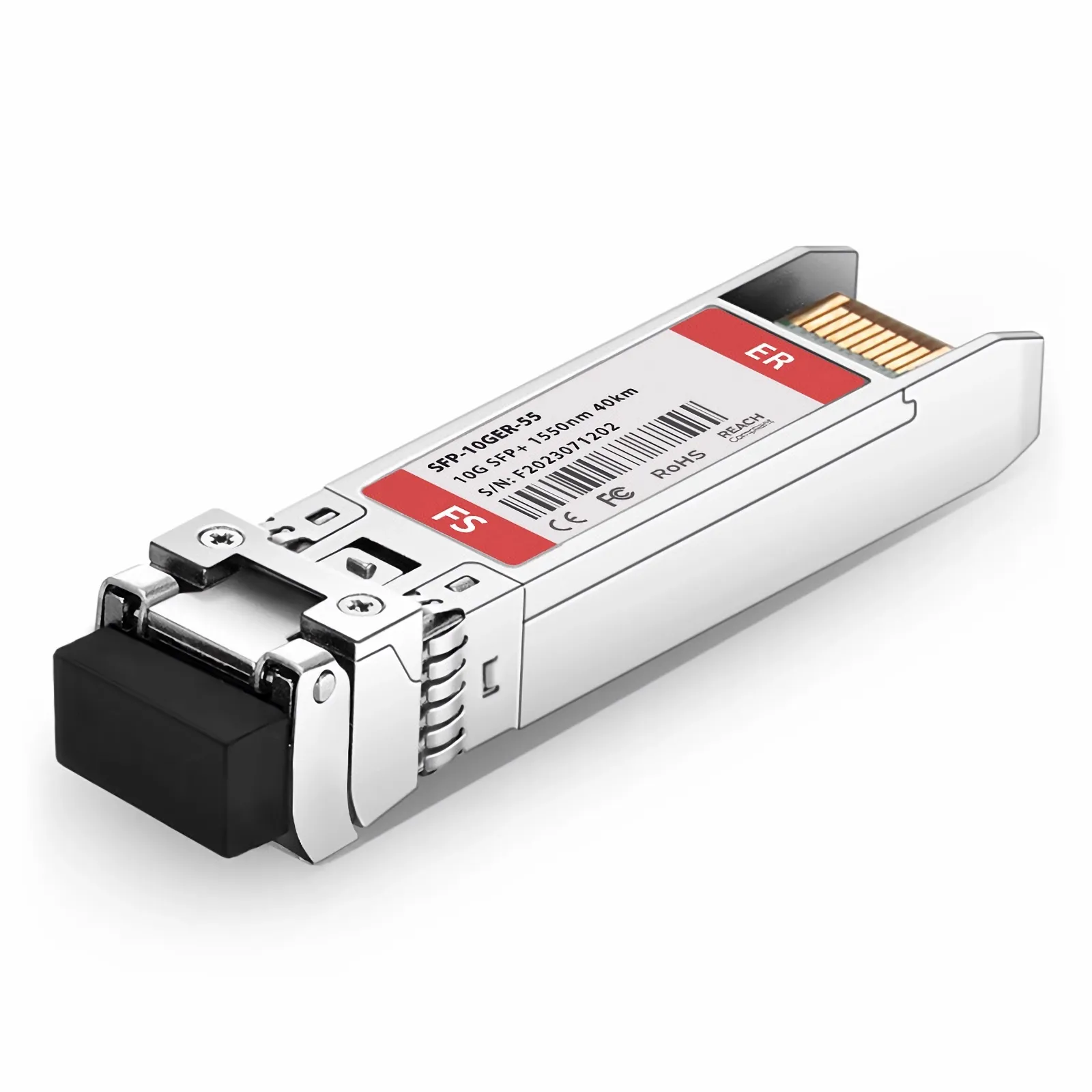
Cisco SFP+ Series Transceiver Module SFP-10G-ER
The Cisco SFP+ Series Transceiver Module SFP-10G-ER delivers high-performance 10 Gigabit Ethernet connectivity over single-mode fiber optic cabling for extended-distance network applications requiring reliable long-haul connectivity. This extended-reach transceiver supports transmission distances up to 40 kilometers, making it ideal for metropolitan area networks, inter-city data center connections, and wide-area network deployments spanning significant geographical distances.
Moreover, the SFP-10G-ER provides hot-swappable operation and comprehensive digital diagnostic monitoring capabilities, thereby enabling flexible network architecture design and proactive link performance management without service disruptions.
Key Features & Benefits
- 40km Extended Transmission Distance: Supports single-mode fiber connections up to 40 kilometers at full 10 Gigabit Ethernet speeds, enabling connectivity across metropolitan areas and between geographically dispersed facilities. Consequently, organizations can interconnect remote data centers, establish disaster recovery links, or connect to carrier points of presence without requiring intermediate optical amplification or signal regeneration equipment.
- 1550nm Wavelength Operation: Utilizes industry-standard 1550nm wavelength optimized for long-distance single-mode fiber transmission with minimal attenuation and dispersion. Furthermore, this wavelength choice provides maximum transmission distance capability over existing fiber infrastructure while maintaining signal integrity and reliable data delivery across extended fiber spans.
- Hot-Swappable Capability: Allows installation and removal while host network equipment remains powered and operational, eliminating scheduled maintenance windows for transceiver replacement or upgrades. As a result, network administrators can perform troubleshooting, conduct equipment swaps, and implement network modifications without disrupting critical business services or requiring complex change management procedures.
- Digital Optical Monitoring (DOM): Provides real-time telemetry including optical transmit power, receive power, temperature, laser bias current, and supply voltage through standard management interfaces. In addition, this comprehensive monitoring enables proactive identification of fiber degradation, predicts component failures before service impact, and facilitates data-driven maintenance strategies for optimizing network reliability.
- Broad Platform Compatibility: Supports deployment across extensive Cisco product portfolios including enterprise switches, service provider routers, data center fabric switches, and network interface cards equipped with SFP+ transceiver slots. Therefore, organizations can standardize on proven optical connectivity solutions across diverse networking environments while simplifying inventory management and reducing spare parts complexity.
Technical Specifications
Optical Performance
- Data Rate: 10 Gigabit Ethernet (10GBASE-ER)
- Wavelength: 1550nm nominal
- Fiber Type: Single-mode fiber (SMF) 9/125 micron
- Maximum Distance: 40 kilometers (24.9 miles)
- Transmit Power: 0 dBm to +4 dBm typical
- Receiver Sensitivity: -15 dBm minimum
- Optical Connector: Duplex LC connector
- Spectral Width: 1nm maximum (RMS)
Electrical Interface
- Host Interface: SFP+ (Enhanced Small Form-factor Pluggable)
- Data Rate Support: 9.95 Gbps to 11.1 Gbps
- Encoding: 64B/66B line encoding
- Signal Detect: Differential LVPECL outputs
- Power Supply: 3.3V single power supply
- Jitter Tolerance: Per IEEE 802.3ae specifications
Digital Diagnostics
- Monitoring Functions: Temperature, voltage, laser bias current, transmit optical power, receive optical power
- Alarm/Warning Thresholds: User-configurable high/low limits for all monitored parameters
- Interface: I2C serial interface compliant with SFF-8472 specification
- Calibration: Internal or external calibration support
- Update Rate: Real-time parameter updates for continuous monitoring
Physical Specifications
- Form Factor: SFP+ MSA compliant
- Dimensions: 56.5mm x 13.7mm x 8.5mm (2.2″ x 0.54″ x 0.33″)
- Weight: 40 grams (1.4 oz) typical
- Connector Type: Duplex LC optical interface
- Pull Tab: Metal extraction handle for secure removal
- Latching: Bail clasp retention mechanism per MSA standards
- Laser Classification: Class 1 laser product per IEC 60825-1
Power & Environmental
- Power Consumption: 2.0W maximum
- Operating Temperature: 0°C to 70°C (32°F to 158°F) standard commercial range
- Storage Temperature: -40°C to 85°C (-40°F to 185°F)
- Operating Humidity: 5% to 85% non-condensing
- Storage Humidity: 5% to 95% non-condensing
- MTBF: Greater than 1,000,000 hours at 25°C
Compliance & Standards
- IEEE Standards: IEEE 802.3ae 10GBASE-ER
- MSA Compliance: SFP+ Multi-Source Agreement
- Diagnostic Monitoring: SFF-8472 Digital Diagnostic Monitoring Interface specification
- Safety: UL 60950-1, CSA 60950-1, EN 60950-1, IEC 60950-1
- EMC: FCC Part 15 Class B, CE Mark, VCCI Class B
- RoHS: RoHS-6 compliant (lead-free manufacturing)
- Laser Safety: IEC 60825-1, FDA 21 CFR 1040.10 and 1040.11
Link Budget & Fiber Requirements
- Link Budget: Minimum 15 dB typical
- Maximum Insertion Loss: 11.0 dB at 1550nm
- Connector Type Required: LC duplex single-mode fiber patch cables
- Fiber Core/Cladding: 9/125 micron single-mode fiber
- Cable Standards: OS1 or OS2 single-mode fiber cable recommended
- Maximum Channel Attenuation: 11 dB including connectors and splices
Use Cases & Applications
Metropolitan Area Network (MAN) Deployments
The SFP-10G-ER serves as the foundation for metropolitan area network infrastructure connecting enterprise facilities, data centers, and branch offices across cities and surrounding regions. Additionally, the 40-kilometer reach accommodates typical metro-area distances without requiring expensive optical amplification equipment or intermediate regeneration sites.
Furthermore, organizations leasing dark fiber infrastructure from telecommunications providers can establish cost-effective private networks with predictable performance characteristics and complete control over network traffic.
Disaster Recovery and Business Continuity
Enterprise IT organizations implement the Cisco SFP-10G-ER for connecting primary production data centers to geographically separated disaster recovery facilities ensuring business continuity during catastrophic events. Moreover, the extended 40km range enables sufficient physical separation between sites to meet regulatory requirements and best practices for disaster recovery planning.
Specifically, synchronous storage replication, database mirroring, and real-time backup applications benefit from the low-latency, high-bandwidth connectivity supporting recovery point objectives (RPO) measured in seconds rather than hours.
Carrier and Service Provider Networks
Telecommunications carriers and internet service providers deploy the SFP-10G-ER in metro and regional network infrastructure aggregating customer traffic and connecting central offices across service territories. Notably, the transceiver supports wholesale Ethernet services including E-Line and E-LAN offerings delivered to enterprise customers requiring dedicated high-capacity circuits.
Meanwhile, the comprehensive digital optical monitoring capabilities enable service level agreement (SLA) compliance verification and proactive network maintenance reducing mean time to repair (MTTR) for customer-affecting issues.
Inter-City Data Center Connectivity
Cloud service providers and large enterprises utilize the Cisco SFP-10G-ER for establishing dedicated connectivity between data centers located in different cities within regional service areas. Additionally, the extended reach supports connections between urban core data centers and suburban facilities offering lower operating costs and improved disaster recovery positioning.
Therefore, organizations can distribute workloads geographically while maintaining low-latency connectivity for distributed application architectures and hybrid cloud deployments.
Financial Services Trading Networks
Financial institutions deploy the SFP-10G-ER for connecting trading floors, data centers, and exchange access points across metropolitan financial districts requiring microsecond-level latency performance. Furthermore, the predictable transmission characteristics of dedicated fiber connections support high-frequency trading applications where network jitter and latency directly impact trading profitability.
In addition, the transceiver’s reliability and performance consistency meet stringent requirements for financial transaction processing and market data distribution.
Government and Defense Networks
Government agencies and defense organizations implement the Cisco SFP-10G-ER for secure network connectivity between facilities, command centers, and data repositories requiring dedicated fiber infrastructure. Specifically, the extended transmission distance accommodates base-to-base connectivity and facility interconnection across large government installations without relying on commercial telecommunications infrastructure.
Moreover, organizations can implement encryption at layer 2 or layer 3 while maintaining full 10 Gigabit throughput for classified data transmission across secure fiber networks.
Healthcare System Integration
Regional healthcare networks leverage the SFP-10G-ER for connecting hospital campuses, specialty care centers, and imaging facilities across metropolitan healthcare systems requiring HIPAA-compliant network infrastructure. Additionally, the high bandwidth supports enterprise medical imaging archives transmitting computed tomography (CT), magnetic resonance imaging (MRI), and digital pathology images between facilities for specialist consultation and diagnosis.
Consequently, healthcare providers can deliver coordinated patient care across multiple facilities while maintaining centralized access to comprehensive medical records and diagnostic imaging.
University Research Collaborations
Academic institutions utilize the SFP-10G-ER for establishing research network connections between university campuses, national laboratories, and regional research facilities participating in collaborative scientific investigations. Furthermore, the transceiver supports bandwidth-intensive research applications including radio telescope data correlation, particle accelerator experiment analysis, and climate modeling simulations requiring sustained high-throughput connectivity.
In addition, research and education networks leverage the extended reach for connecting campus networks to regional and national backbone infrastructure supporting international scientific collaboration.
Compatibility & Deployment
The Cisco SFP-10G-ER transceiver module maintains extensive compatibility with Cisco networking platforms including Catalyst enterprise switches, Nexus data center switches, ASR aggregation service routers, CRS carrier routing systems, and various network interface cards supporting SFP+ form factor transceivers. Consequently, organizations can deploy consistent optical connectivity solutions across diverse networking environments ranging from enterprise campus networks to service provider core infrastructure.
For optimal performance and full feature support, Cisco recommends deploying genuine Cisco transceivers with Cisco equipment to ensure compatibility with advanced features, eligibility for technical assistance center (TAC) support, and coverage under SmartNet service contracts. Additionally, the transceiver supports installation in multi-vendor networking equipment complying with SFP+ MSA specifications, though organizations should verify compatibility with specific third-party platforms before large-scale deployment.
Furthermore, successful long-distance transmission requires proper fiber optic infrastructure including high-quality OS2 single-mode fiber, clean LC connectors maintained according to industry best practices, and appropriate splice loss budgets accounting for all passive components in the optical path. Moreover, network administrators should establish baseline performance metrics using the digital optical monitoring features during initial installation, enabling trend analysis and early detection of fiber degradation, connector contamination, or transceiver aging that could impact link reliability.
In addition, organizations deploying extended-reach transceivers should consider environmental factors including fiber route diversity for redundancy, physical security of fiber pathways, and documentation of fiber infrastructure for efficient troubleshooting and future capacity planning initiatives.
 No products in the cart.
Reviews
There are no reviews yet.